
MoClo | Hyundai Motor Group PBV Hackathon - 1st Winner
UI/UX Prototype / Proposal
A PBV-Powered Mobile Fitting Room Concept

PROJECT OVERVIEW
MoClo (short for Moving Closet) reimagines the fitting room as something that comes to you, instead of the other way around. Built on Hyundai Motor Group's PBV (Platform Beyond Vehicle) — a modular, purpose-built electric vehicle platform — MoClo is a mobile retail unit that delivers in-stock apparel to a customer's chosen location, lets them try items on in a private onboard fitting room, and handles checkout and returns on the spot.
The concept was developed as a team case study exploring how physical retail and mobility infrastructure could be combined to remove the two biggest pain points in fashion e-commerce: sizing uncertainty and the returns process.
MoClo - Shopping can be simpler, with MoClo.
ROLE
-
UI/UX Researcher
-
Product Designer
TOOLS
-
Figma
-
Adobe Creative Suite

The Problem
Online apparel shopping is convenient until something doesn't fit. At that point, the "convenience" reverses into friction: repackaging an item, printing a label, and making a special trip to a carrier drop-off.
Industry research bears this out. In a 2022 retail returns survey cited in our research, respondents identified paying for shipping (36%), items not arriving (33%), and traveling to the post office (31%) as the most-hated parts of the returns process — and strikingly, 58% of shoppers said they'd do "nearly anything" to avoid returning an item at all.
That statistic became our north star: what if the decision point — trying something on — could happen before the purchase commitment, without requiring a trip to a physical store?
The Idea
"언제 어디서든, 내가 원하는 곳에서" — Anytime, anywhere, wherever I want.
MoClo is a moving closet: a PBV unit stocked with in-season, in-stock inventory that a customer can summon to a location and time of their choosing — home, office, or a nearby public spot. Inside, a private fitting room lets them try on selected pieces in person, while an onboard AI concierge ("Somi") guides the experience and handles payment automatically through the customer's linked account.
Because the try-on happens before purchase, the entire returns funnel — the step 58% of shoppers most want to avoid — is designed out of the experience rather than optimized after the fact.
Persona Research
Persona 1 — The Time-Starved Shopper
Grace, 29, Marketing Coordinator
"I'll order three sizes of the same shirt just so I don't have to guess — and then I dread repackaging the two that don't fit."
-
Goals: Get clothes that fit right the first time; avoid wasting evenings on repackaging and shipping runs.
-
Frustrations: Sizing is inconsistent across brands; her nearest carrier drop-off is a 15-minute detour; she's stopped ordering from smaller brands because returns feel too risky.
-
How MoClo helps: She reserves a 20-minute fitting slot to coincide with her lunch break. The vehicle meets her outside her office; anything that doesn't fit simply never leaves the vehicle, so there's no return to manage afterward.
_edited.png)
Persona 2 — The Accessibility-First Shopper
Daniel, 41, Wheelchair User
_edited.png)
"Most fitting rooms weren't built with me in mind — the doorway's too narrow, or there's a step I can't get over. I usually just don't bother trying things on."
-
Goals: Try on clothing in a space actually built for his mobility needs, without relying on someone else to check whether a store is accessible first.
-
Frustrations: Store fitting rooms are inconsistently accessible; asking staff for help every time feels like a barrier in itself; online sizing is a guessing game when in-store try-on isn't realistic.
-
How MoClo helps: He books a fitting through the app knowing the vehicle's ramp and lowering chassis remove the guesswork. The fitting room itself is sized for his chair, so the appointment is just... shopping, not an accessibility negotiation.
These two personas map directly onto the two design pillars covered later in this case study: the service flow (built around Grace's need for speed and zero-friction returns) and inclusive customization (built around Daniel's need for a physical space that adapts to him, not the other way around).
How the "MoClo" Service Works
1. Discover & Reserve
The customer browses in-stock items near them through the MoClo app (built to feel like a familiar mobile shopping experience — browse, favorite, cart) and reserves a fitting slot.
2. The Vehicle Arrives
Using location data, the nearest MoClo PBV pulls the reserved items and comes to the customer at their chosen time and place.
3. Private Fitting
The customer steps into the private onboard fitting room for the length of their reserved slot — no rushing, no shared changing rooms, no waiting in line.
4. "Somi," the AI Concierge
An onboard AI mascot assists throughout — surfacing sizing help, styling suggestions, and next steps — turning what could be a transactional pickup into a guided shopping experience.
5. Seamless Checkout
Payment runs automatically through the customer's registered account. Anything that doesn't work simply stays on the vehicle — no box, no label, no drop-off. This is the core innovation: returns are resolved before checkout, not after it.
Designing for Inclusion
A core differentiator for MoClo was treating accessibility as a primary design input rather than an add-on. Because the fitting room is a custom-built physical space (not a fixed storefront), it can be configured per rider:
-
Wheelchair users: A ramp and a lowering chassis at pickup/drop-off, removing the step-in barrier that most physical fitting rooms have.
-
Pregnant customers: A larger fitting-room footprint and provisions for emergency situations.
-
Parents with young children: Onboard child seating and kid-friendly amenities so a fitting appointment doesn't require finding childcare first.
This is also where the PBV platform earns its name — "Platform Beyond Vehicle." The same base vehicle can be reconfigured module-by-module for different rider needs, which is much harder to do with a fixed brick-and-mortar fitting room.
Competitive Analysis
Capability
MoClo
Brandi
Zigzag
Amazon Prime
Offline Shopping
Personalized customization
Multi-brand shopping, one app
Private fitting room
No added time cost
Free returns
No post office visit to return
No repeat trip need to return
The pattern that stood out: every existing option makes the customer trade something away — either convenience, cost, privacy, or brand selection. MoClo was designed so the customer doesn't have to choose, which we translated into three value pillars:
-
Minimizes unnecessary spending from return-related costs
-
Saves time versus both online returns logistics and in-store shopping trips
-
Delivers a private, flexible shopping experience independent of time or location
Go-to-Market Strategy
Rather than launching broad, we scoped a four-phase rollout so the fleet's inventory strategy could mature alongside its footprint:
Phase A — Anchor Partnership Partner with one or two flagship department stores per market (e.g., Westfield in the U.S., Hyundai Department Store in Korea) to validate the model with a trusted, high-traffic retail partner.
Phase B — Retail Network Expansion Broaden the department store partnership base to scale the service across more locations.
Phase C — Warehouse Investment Secure dedicated logistics/warehouse space to pre-stock high-demand items and popular sizes, cutting fulfillment time and improving fleet efficiency.
Phase D — Local Retail Integration Extend partnerships to local and independent stores, broadening selection beyond department-store brands.
Information Architecture
The app is organized around 5 core options for primary navigation:
PRIMARY NAVIGATION
Home (Dashboard)
Category
Reservation
Wishlist
My Profile
Visual Design System
MoClo's visual identity was built to feel like a boutique retail brand rather than a tech/logistics product — warm and tactile, so the "vehicle" part of the concept doesn't read as clinical or industrial.
-
Color palette: using clay terracotta / warm sand / off-white / ink — the palette intentionally avoids typical tech-brand blues and cool neutrals. Terracotta and sand read as apparel/lifestyle-adjacent — closer to a fashion boutique than a mobility startup — which reinforces that the product is the shopping experience, not the vehicle itself.
-
Typography: set in a light-weight serif for the "MoClo" logo — signals craft and boutique positioning at the identity level. A clean geometric sans-serif for all in-app and slide content, prioritizing legibility across English and Korean copy.
-
Logo: the "MoClo" logo appears consistently in the bottom-right corner of every slide/screen as a lightweight brand anchor, and stands alone (no lockup with icon or tagline) on the login screen and closing slide — reserving the full lockup with "Moving Closet for Everyone" for first-touch moments only, so it doesn't compete with content elsewhere.
-
Photography: throughout leans warm and editorial — soft directional lighting, boutique/closet-adjacent settings (hanging racks, walk-in style spaces) — rather than sterile product-catalog shots. This was a deliberate choice to make the "vehicle" part of the concept feel like a private dressing room, not a delivery van.
Key Screens & Flow
Register & Log in
Get a returning customer straight into browsing, and a new customer into a lightweight sign-up.


Home Dashboard & Shopping
Let the customer discover what's actually available near them and build a fitting list — this is the browsing core of the app. Seasonal promotional banner up top (e.g. "Season Sale up to 25% off"); a "What's New Today" grid showing item photo, name, size, and price for nearby in-stock inventory; persistent bottom navigation for quick access to cart, favorites, and profile.
.png)


MoClo Reserve & Tracking
Convert a wish list into a scheduled, trackable fitting appointment. Time-slot and location picker for where the vehicle should meet the customer; a running summary of items selected for the fitting; once confirmed, a live map view showing the assigned PBV's position and ETA — the same mental model as a rideshare or delivery tracker customers already trust.


Receipt & Notification
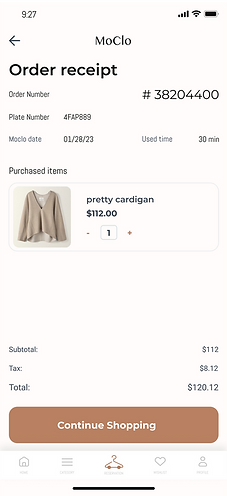
Close the loop with zero extra steps for the customer — no packaging, no return label, no separate trip. Itemized receipt showing only what the customer chose to keep, auto-charged via their registered payment method; a notification confirming the transaction and, where relevant, that unkept items were left with the vehicle rather than needing to be returned separately.


MoClo Arrival & Entry Code
Securely and confidently get the customer into the vehicle once it arrives. Arrival confirmation state, a unique entry code (PIN or QR) generated per reservation, and clear next-step instructions for approaching and entering the vehicle.
Somi's role: Once inside, Somi takes over as the in-fitting-room concierge — this is where the assistant actively helps with sizing, styling, and requesting a different size or item.


Final Prototype
Flow at a Glance
Register & Log In
Home Dashboard
Shopping
MoClo Reserve
Tracking
MoClo Arrival & Entry Code
Receipt & Notification
Two moments carry the most design weight in this flow: Reserve & Tracking, which has to make an unfamiliar vehicle-based appointment feel as trustworthy as a rideshare booking, and Receipt & Notification, which is the payoff screen proving the entire "no returns" promise actually held — the customer only ever pays for what they kept, and the flow simply ends there.
Brand Introduction
What
"MoClo"
Means ?
Moving + Closet.
The name is literal by design — it tells you exactly what the product is before you read another word: a closet that comes to you, rather than a store you have to go to.
Our Mission
To make trying on clothes as easy as trying nothing at all — removing the two biggest costs of shopping today, uncertainty and inconvenience, without asking the customer to compromise on privacy, fit, or accessibility.
Our Features
-
Retail — the product is still, fundamentally, clothes you can touch and try before you buy.
-
Mobility — built on Hyundai's PBV platform, so the "store" is a vehicle, not a lease.
-
Accessibility service — a modular fitting room that adapts to the rider, not the other way around.
"MoClo" is positioned against competitors, we doesn't compete on price or catalog size — it competes on removing friction other options force customers to accept
_edited.png)
_edited.png)
_edited.png)
Accessibility
Service
Retail
Mobility
Somi — The Brand's Voice in Product
Somi is more than an in-app feature; it's the brand's personality made interactive. Where the visual identity sets the tone (warm, boutique, calm), Somi is where customers actually experience that tone — in how fitting suggestions are phrased, how a size swap is offered, and how the checkout moment closes without any pressure to justify what wasn't kept.
.png)
-
AR mirror styling recommendations — Somi suggests clothing and accessories through an AR mirror, with potential ad-based revenue from brand placements.
-
Accessibility-tailored service — Somi adapts to each customer's needs, e.g. braille support for visually impaired users, screen-reader integration for hearing-impaired users.
-
Save-for-next-delivery — if a customer likes something Somi recommended, they can add it to their next scheduled delivery instead of starting a new order.
Overall Design Objectives
Every design decision in MoClo — service flow, accessibility, visuals, Somi's behavior — was tested against these objectives:
-
Resolve fit before purchase. Move try-on ahead of payment, so returns are designed out rather than handled after the fact.
-
Build accessibility into the vehicle, not a settings menu. Ramps, lowering chassis, and adjustable fitting rooms solve problems a toggle can't.
-
Borrow trust from familiar patterns. Rideshare-style tracking, delivery-style entry codes, standard e-commerce browsing — the vehicle is new, the interactions aren't.
-
Minimize decisions per screen. One clear action per step, no split flows or redundant confirmations.
-
Let Somi carry the brand's warmth. Helpful, not salesy — the personality lives in the interaction, not just the palette.
-
Design for scale from day one. Every choice is evaluated against working at 100 vehicles, not just 1.
